Table of content

Use this discount calculator to work out sale price, money saved, and discount percentage in seconds. Whether you need a quick discount calc, a discount price calculator, or a simple calculator discount tool while shopping, this page gives the result fast and keeps the explanation easy to follow.
Using the discount calculator is simple. Just follow these steps to get the final price and total savings in seconds.
Enter the original price
Type in the full price of the item before any discount is applied.
Add the discount value
Enter the discount as a percentage or a fixed amount, depending on how the offer is shown.
Include tax if needed
If the calculator has a tax field, add it to get a result that is closer to the final checkout price.
Click calculate
The tool will process the numbers and show the updated result right away.
Check your results
Review the final price, discount amount, and total savings before making your purchase.
This format works well for quick shopping decisions, coupon checks, and comparing sale offers without doing the math manually.
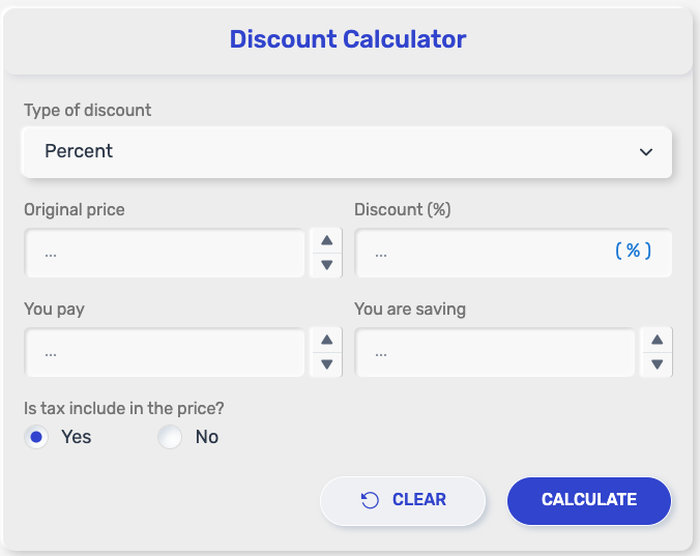
A good discount calculator does more than show a lower price. It gives you a full view of the deal, so you can see what you are paying, what you are saving, and whether the offer is really worth it. Whether you are using a quick discount calc during a sale or a discount calculator online while comparing stores, these are the most common results you can expect.
Final price after discount
This is the new price after the discount is applied to the original amount.
Total amount saved
This shows exactly how much money is taken off the original price.
Discount percentage
If you know the original price and the sale price, the tool can calculate the percentage discount.
Original price
Some tools can work backward and show the starting price based on the sale price and discount rate.
Price after a fixed discount
Not every offer is a percentage. A discount price calculator can also work with flat discounts like $10 off or $25 off.
Price after tax and discount
If tax is included, the calculator can give a closer estimate of the full amount due at checkout.
Multiple discounts on one item
Some offers include stacked discounts, such as a sale price plus a coupon code.
Quick price comparison between deals
A price discount calculator makes it easier to compare two promotions and see which one gives better value.
This makes the calculator useful for shopping, coupon checks, sale events, and everyday price comparisons.
A quick check before you calculate can make the result more reliable. This is especially useful when you are comparing sale offers or checking the final cost before checkout.
Use the correct discount type
Make sure the offer is entered as a percentage or a fixed amount.
Check if tax is included
Some results show the price before tax, while others include it.
Enter the original price carefully
A small mistake in the starting price changes the whole result.
Do not combine discounts too quickly
Multiple discounts are often applied one after another, not added together.
Round at the end
This gives a cleaner and more accurate final number.
These small steps can give you a clearer result and make deal comparisons easier.
A discount calculator uses a simple set of formulas to show how much you save and what you actually pay. Once you know the original price and the discount rate, the math is direct and easy to follow.
1. Discount AmountDiscount Amount = Original Price × Discount Percentage
This tells you how much money is taken off the original price.
2. Final Price After DiscountFinal Price = Original Price − Discount Amount
This shows the sale price after the discount is applied.
3. Discount PercentageDiscount Percentage = (Discount Amount ÷ Original Price) × 100
Use this formula when you know the amount saved and want to find the discount rate.
4. Original Price From Sale PriceOriginal Price = Sale Price ÷ (1 − Discount Percentage)
This works when you know the final sale price and the discount rate, but not the starting price.
For example, if an item costs $100 and the discount is 20%, the discount amount is $20. The final price is $80. This is the same logic used by a discount calculator online, whether you are checking a store sale, comparing coupon offers, or working out the best price before checkout.
If you want to see a quick visual explanation, you can watch this short video on how discount calculations work:
Not every discount works the same way. Some offers reduce the price by a percentage, while others take off a fixed amount. At first glance, both can look equally attractive, but the better deal depends on the original price of the item. This is why many shoppers use a discount calculator before making a decision.
Some discount rates appear again and again in stores, online sales, coupon offers, and clearance events. A few quick examples make it easier to judge whether a deal is worth it before you buy.
A 10% discount is one of the easiest sale prices to estimate.
$50 item → save $5 → final price $45$80 item → save $8 → final price $72$120 item → save $12 → final price $108This type of discount is common for welcome offers, first-order coupons, and smaller promotions.
A 20% discount is also easy to work out because it means saving $20 for every $100 spent.
$50 item → save $10 → final price $40$100 item → save $20 → final price $80$250 item → save $50 → final price $200This is a popular rate during seasonal sales and limited-time online promotions.
Yes. The math works the same way for any currency. The result will match the numbers you enter, whether you are using dollars, euros, pounds, or another unit.
What is the difference between savings and final price?
Yes. It works well for online shopping, store promotions, seasonal sales, and clearance events.
Because the original price matters too. A smaller percentage on a high-priced item can save more money than a larger percentage on a lower-priced item.
Usually yes, but small differences can happen because of rounding rules, taxes, or store-specific pricing systems.
Discountcalculatoronline.com was created to help shoppers, students, and everyday users quickly figure out sale prices, percentage discounts, and final costs without the hassle of manual math. Whether you're comparing deals, planning a budget, or checking how much you really save, this tool gives you fast answers in a clear and practical way.
This tool was brought to life by the Discountcalculatoronline.com team, with contributions from developers, designers, and content specialists who work together to create smart, accessible tools that make everyday calculations easier.
We keep things simple—just like the calculator itself.
Discountcalculatoronline.com doesn’t ask for accounts or personal details. The numbers you enter stay on your device and are only used to show instant results.
This tool helps you calculate discounts and final prices based on your input. However, actual prices may vary due to taxes, shipping fees, store policies, or rounding differences at checkout.
Whether you're shopping online, in-store, or planning a budget, this calculator is here to assist—not replace official pricing. Always double-check final amounts before making a purchase.
We may update or improve this tool over time. Any changes to this Policy will be posted here so everything stays clear and transparent."